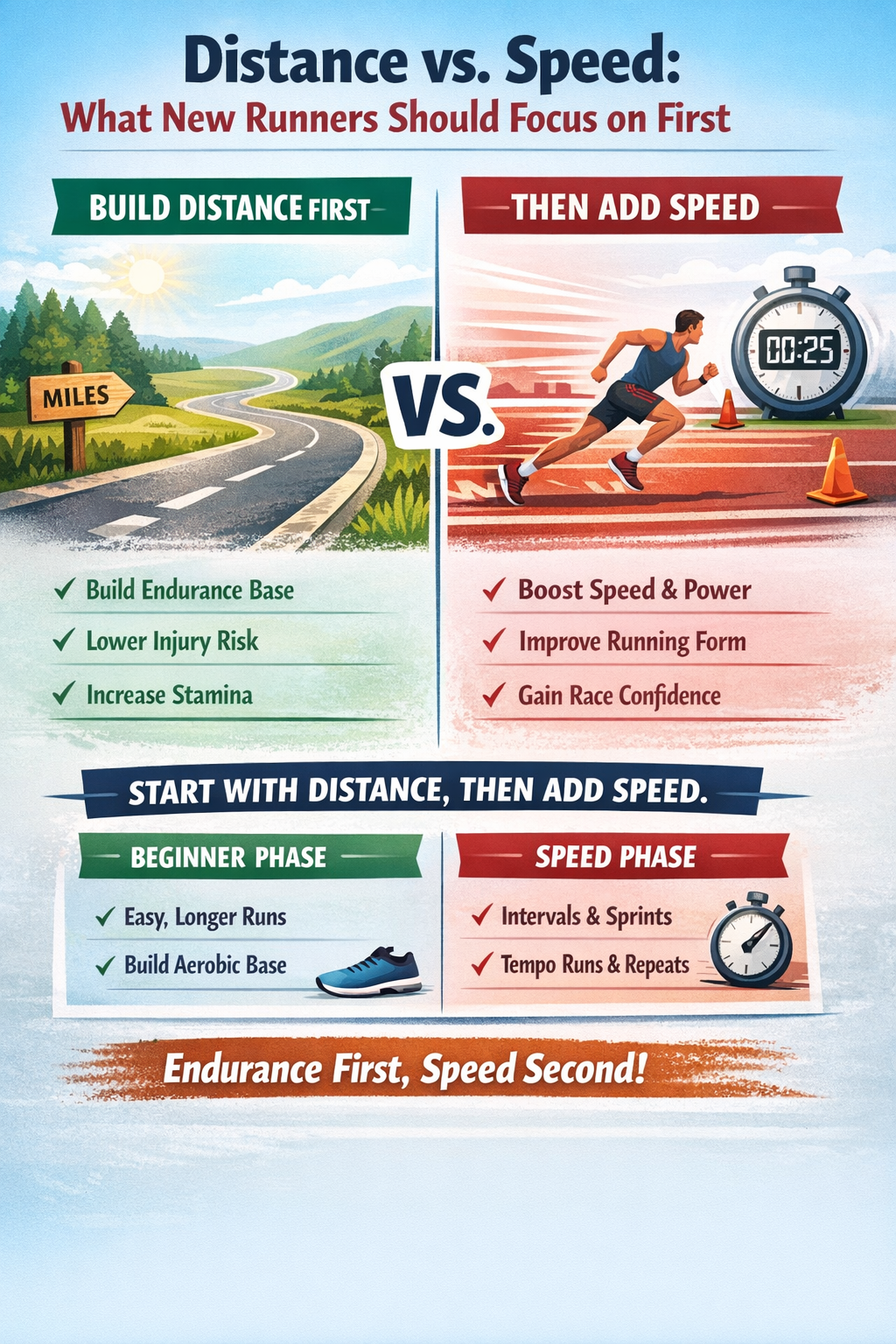

Building a Strong Foundation: Distance Before Speed for New Runners
Published: March 25, 2026

When you're starting your running journey, a fundamental question emerges: should you focus on building distance or developing speed first? The temptation to chase faster times early is understandable—completing a kilometre more quickly feels like concrete progress. However, most beginning runners experience faster overall improvement by prioritising distance development in their early weeks and months.
Establishing a solid aerobic foundation makes subsequent training feel more manageable, strengthens the physiological systems needed for more challenging workouts, significantly reduces injury risk, and creates the fitness platform necessary for later speed development.
This article explores why distance forms the essential first phase of your running development, practical methods for building this base safely, and the appropriate timing and progression for introducing faster-paced sessions.
Table of Contents
- Why distance comes before speed for beginning runners
- Proven strategies for building distance safely
- When and how to incorporate speed training
- Key takeaways
Why Distance Comes Before Speed for Beginning Runners
Understanding the physiological reasons behind this progression helps you approach your training with intentionality rather than impatience.
Speed work demands a great deal from your body. Each time you increase your pace, the demands on your cardiovascular system, muscles, skeletal structures, and connective tissues escalate significantly.
Beginning speed training before your body has adapted to consistent, steady-paced running places excessive stress on systems that haven't yet developed adequate resilience. This is precisely when uncomfortable injuries emerge—shin pain, tight calf muscles, knee discomfort, and general fatigue.
Distance-focused training, conversely, develops your foundational aerobic fitness. Longer runs performed at comfortable paces train your heart and lungs to extract and utilise oxygen with greater efficiency. This process builds additional capillaries throughout your muscles, strengthens the connective tissues supporting your joints, and accustoms your body to the repetitive impact of running—ultimately creating a more resilient system capable of handling future intensity.
There's also a practical reality: if you're preparing for your first 5K or 10K race, you need the stamina to cover that distance habitually before worrying about your pace. A rapid first kilometre provides little benefit if you're forced to walk the remainder because your energy reserves have depleted.
Once you can complete your target distance at a comfortable, conversational pace multiple times weekly, you possess the fitness foundation to safely absorb more demanding training. This is the appropriate moment to introduce progressive speed sessions—such as short interval repeats or controlled faster-paced efforts.
At this stage, your underlying fitness can tolerate the additional stress, and these faster sessions will genuinely improve your performance.
Proven Strategies for Building Distance Safely
Now that you understand the importance of distance development, here are the most effective approaches for building it sustainably. Developing endurance requires consistent patience, but applying these core principles enables you to extend your weekly volume while avoiding setbacks.
1. Employ a Run-Walk-Run Strategy
You don't need to maintain continuous running throughout every workout to develop your running capacity. Strategically mixing running segments with walking periods allows you to sustain longer total durations, manage accumulated fatigue, and build confidence progressively.
Begin with modest ratios like 1 minute of running followed by 2 minutes of walking, then progress to extended running segments—2:2, 3:2, or 4:1—as your fitness improves. Gradually shorten the walking intervals and transition toward continuous running.
2. Maintain a Genuinely Easy Pace
A very common mistake among beginners involves running too quickly during routine training runs. The correct intensity allows you to sustain a conversation in complete sentences without strain. If your breathing has become laboured or you're mentally waiting for the session to finish, your pace is too fast.
Most individuals can actually run considerably farther than they initially believe; it's typically pacing choices—rather than actual fitness limitations—that prevent progress.
3. Increase Your Weekly Volume Gradually
A reliable principle: increase your total weekly distance by no more than 10 percent at a time. If you're currently running 11 kilometres weekly, advance to approximately 12.1 kilometres, maintain this level until it feels manageable, then increase again gradually.
These conservative increments effectively protect you from common beginner-runner injuries including shin splints, plantar fasciitis, and related issues.
When and How to Incorporate Speed Training
Following 4-6 weeks of consistent training, you can begin introducing straightforward speed elements into your routine.
1. Introduce Strides
Once per week, add four to six brief acceleration efforts at the conclusion of your run. Each acceleration lasts approximately 20–30 seconds at a controlled fast pace, with a full recovery jog between efforts. Strides enhance your running cadence and movement patterns without imposing substantial additional strain.
2. Finish with Increased Pace
Another uncomplicated introduction: gradually increase your running pace during the final few minutes of a standard run. Think of this as teaching your body to shift into higher effort when fatigued—a practical skill that becomes invaluable during racing situations.
Once your body responds positively to strides and gentle pace increases, you can introduce more structured sessions like proper intervals, fartlek training, tempo efforts, or longer-distance repeats.
3. Fartlek Sessions
Accelerate slightly for approximately two minutes, then recover through easy jogging for about four minutes. Repeat this pattern multiple times. This unstructured approach is enjoyable and effectively develops speed without rigid training constraints.
4. Tempo Runs
After a proper warm-up period, settle into a comfortably hard pace—approximately 6–7 seconds per kilometre slower than your goal 5K race pace—and sustain this effort for 20–25 minutes. This intensity improves your lactate clearing ability, enabling you to maintain faster speeds for extended periods.
5. Kilometre Repeats
Run kilometre segments at a pace that feels comfortably hard—approximately 9–15 seconds per kilometre faster than your current 5K pace. You should be able to complete the full kilometre at this pace but not comfortably maintain a conversation.
If you finish gasping for breath or struggle to recover during the recovery jog, you're pushing too intensely; if you feel capable of running substantially faster, your effort level is insufficient.
6. Interval Sessions
Alternate brief, harder efforts with equivalent or slightly longer easy-paced recovery segments:
- 30-second pickups: Run 30 seconds at faster pace, then jog or walk for 90 seconds; repeat 6–10 times.
- 1-minute intervals: Run 1 minute faster than easy pace, then jog for 2 minutes; repeat 5–8 times.
- 2-minute intervals: Run 2 minutes at a steady harder effort, then jog for 2–3 minutes; repeat 4–6 times.
Always include a thorough warm-up and cool-down surrounding each speed session.
Key Takeaways
Distance forms the foundation. Speed development follows naturally afterward. While speed training enhances your fitness, strength, and aerobic capacity, it requires a distance-based endurance foundation to be pursued safely and return meaningful results.
If you're beginning your running journey, dedicate your first several weeks to building your weekly distance at conversational paces. Once you can comfortably handle your target distances, progressively introduce speed work into your training schedule.
As you develop further, balancing distance and speed in your training creates more varied and rewarding running experiences while preparing you for whatever racing distance you ultimately choose to pursue.