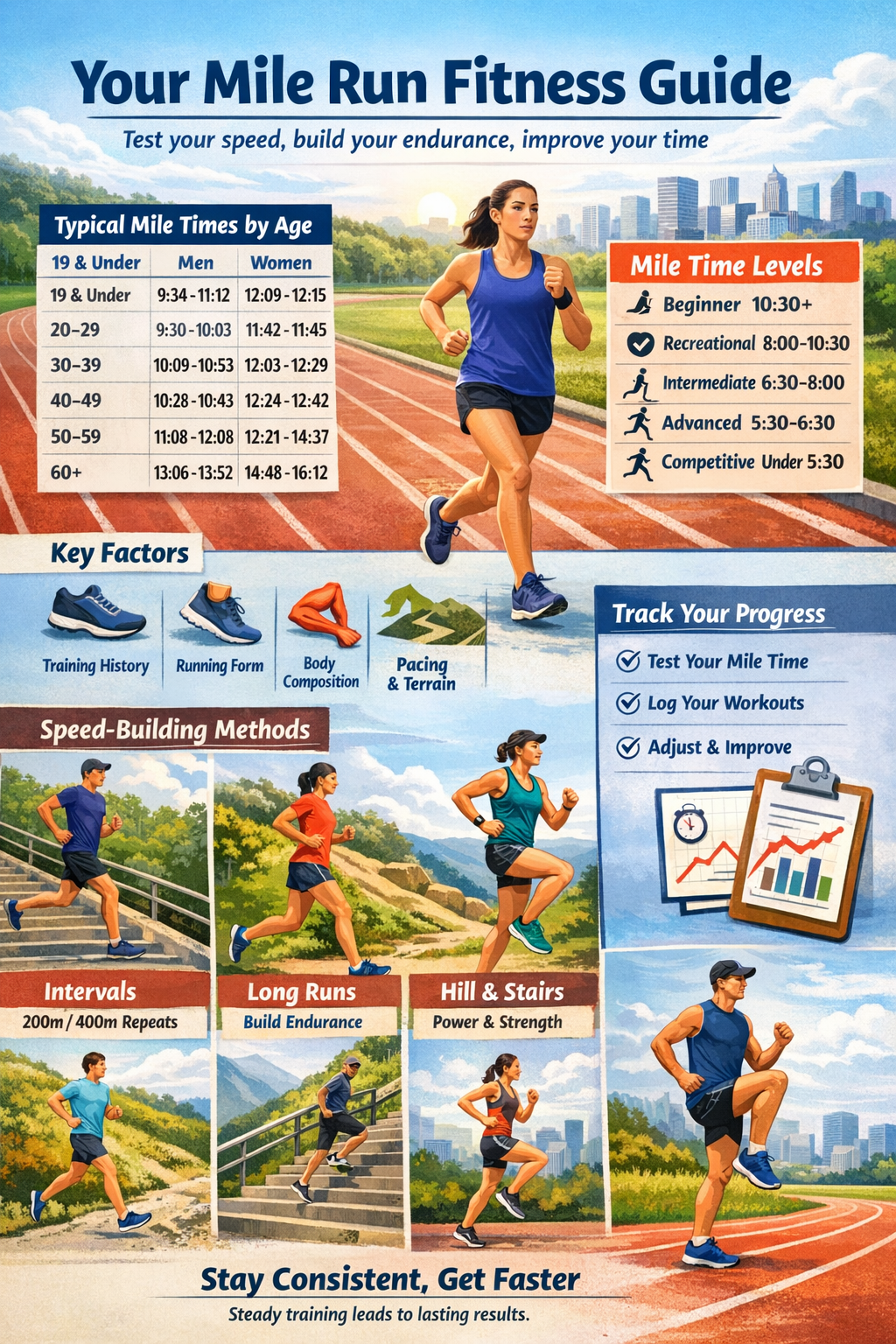

How to Run Your Fastest Kilometre: 6 Effective Methods to Improve Speed
Published: March 23, 2026

What's a good kilometre time—and how to run a faster one.
The kilometre is one of the clearest ways to check your running fitness. It's short enough to test without special preparation, but long enough to reveal how well you pace yourself, how efficient your stride is, and how much endurance you've built.
Whether you're new to running or working toward longer races, knowing your kilometre time helps you understand where your fitness stands and how to make progress.
This guide breaks down typical kilometre times, the factors that influence them, and the training methods that help runners at any level get faster.
Table of Contents
- Understanding what a "good" kilometre time looks like
- Factors that influence your kilometre time
- How to get your baseline kilometre
- How to run a faster kilometre: 6 speed-building training methods
- How long does improvement take?
- Putting it all together
Understanding what a "good" kilometre time looks like
Many runners wonder what counts as a "good" kilometre time. The answer depends on your age, sex, background, and weekly training volume.
Younger runners typically produce faster results thanks to natural speed and higher recovery capacity. Times gradually slow with age, but steady training can maintain strong performance for decades.
On average, recreational adults who run consistently fall somewhere between 3:45 and 6:15 minutes per kilometre. Beginners may run slower, and competitive runners—especially those with track backgrounds—run much faster.
Rather than chasing a single target, it's more productive to understand common ranges and focus on improving your personal baseline.
Average kilometre times by age group
| Age group | Men (per km) | Women (per km) |
|---|---|---|
| 19 and under | 5:56 – 6:56 | 7:34 – 7:38 |
| 20–29 | 5:54 – 6:14 | 7:16 – 7:18 |
| 30–39 | 6:18 – 6:45 | 7:28 – 7:45 |
| 40–49 | 6:29 – 6:38 | 7:42 – 7:54 |
| 50–59 | 6:52 – 7:31 | 8:18 – 9:05 |
| 60–99 | 8:08 – 8:36 | 9:12 – 10:04 |
Kilometre time standards
| Category | Men (km time) | Women (km time) | Description |
|---|---|---|---|
| Beginner | 6:32+ | 7:54+ | New to running, building base. |
| Recreational | 4:58 – 6:32 | 6:14 – 7:54 | Runs several times per week; typical range for most adult runners. |
| Intermediate | 4:02 – 4:58 | 4:40 – 6:14 | Trains consistently, includes speedwork; solid endurance background. |
| Advanced | 3:24 – 4:02 | 4:02 – 4:40 | Performs structured training; strong running economy and weekly volume. |
| Competitive | 2:56 – 3:24 | 3:24 – 4:02 | Club-level/collegiate fitness; race-tested speed. |
| Elite | Sub-2:48 | Sub-3:24 | National-level speed; highly trained athletes with track background. |
Factors that influence your kilometre time
Your current pace is shaped by many factors:
- Training history. Runners with steady weekly volume typically carry more endurance and better form.
- Muscle strength and running economy. Efficient mechanics help you hold pace without wasting energy.
- Body composition. Weight, muscle distribution, and overall fitness affect how quickly you can move through a full kilometre.
- Heat and terrain. A track or flat paved road produces different times than hills or trails.
- Pacing strategy. Many runners start too fast and fade; controlled pacing leads to more accurate results.
Understanding these variables helps you interpret your kilometre time more realistically and avoid harsh self-comparisons.
How to get your baseline kilometre
Before you try to improve your kilometre time, establish a clear baseline.
- Choose a measured route, a track, or a GPS-verified distance.
- Warm up first with five to ten minutes of easy jogging and a few short strides to loosen your legs.
- Run the kilometre at a strong, steady effort. It should feel challenging by the final quarter but not like an all-out sprint from the start.
- Record your time, note how the pace felt, and give yourself adequate recovery afterward.
- Repeat this test every four to eight weeks. The goal is to see whether your training is moving you forward.
How to run a faster kilometre: 6 speed-building training methods
1. Add interval training once a week
Short, fast repeats develop the speed, rhythm, and confidence you need for a quicker kilometre. After a 5–10 minute warm-up, alternate between faster running and easy recovery.
- 200-metre repeats: Run 200 metres hard, then jog or walk 200 metres. Start with 6 repeats and build toward 8–10.
- 400-metre repeats: Run 400 metres at a controlled but strong pace, followed by a full recovery lap. Begin with 2–3 repeats and progress to 5–6.
If you're training on the road, use landmarks: sprint between two lamp posts, then recover for the next two. These intervals also work well on a treadmill.
To choose the right pace for intervals, aim for an effort that feels faster than your kilometre pace. A simple rule: you should finish each repeat breathing hard but able to recover fully during the rest.
If you know your current kilometre time, run 200s and 400s at a pace that's slightly quicker—about 3–6 seconds faster per 400 metres. If you don't know your exact pace, use effort instead: run fast, but hold back from sprinting.
2. Build endurance with longer runs
A strong kilometre depends on aerobic capacity. Running longer distances gives you the stamina to hold your pace through the final quarter of a kilometre.
Increase your long run gradually—about 1–1.5 km per week—until you can comfortably run 11–13 km. Maintain total weekly distance increases around 10% per week to reduce injury risk.
One longer run per week builds cardiovascular strength and mental resilience, which directly influence kilometre performance.
If you're training for a half or full marathon, your long run progression will already be part of your broader plan.
3. Run hills regularly
Hill repeats build strength, raise your lactate threshold, and teach you how to maintain form under effort—all of which directly benefit kilometre performance.
Warm up for 10–15 minutes, then find a moderate incline of about 100–200 metres. Run uphill at your 5K effort, focusing on steady breathing and a controlled stride. At the top, jog or walk down to recover.
How many repeats you do depends on your experience:
- Beginners: start with 2–3 repeats and add one each week for several weeks
- More experienced runners: begin with 6 repeats and progress toward 10
Some downhill running builds coordination and leg resilience, but too much can lead to extra muscle soreness.
Finish with an easy 15-minute cooldown run.
You can also perform incline workouts on a treadmill, although most machines don't allow downhill running.
4. Use stair workouts when hills aren't available
Stairs offer similar benefits to hills and can be a convenient option if you live in a flat area. Look for a staircase long enough to allow 1–2 minutes of continuous climbing.
Run up the stairs for 30 seconds, walk back down to recover, and repeat about 5 times. Build up to 10 repeats over several weeks. As you get fitter, extend the climbing interval.
5. Refine your running form
Small adjustments in posture and cadence can make a noticeable difference in kilometre performance. Focus on:
- Upright posture with relaxed shoulders
- Quick, efficient turnover (more about that below)
- Light footfalls beneath the body
- Smooth arm swing that helps maintain rhythm
Form drills like high knees, skips, and fast-feet strides reinforce these habits without adding heavy training load.
6. Increase stride turnover
Your stride turnover—steps per minute—affects your efficiency and speed.
To find your current cadence, run at your 5K effort and count how many times your right foot hits the ground in one minute. Double the number for total cadence.
Train your turnover with one-minute intervals. Start at your normal rhythm, then repeat while slightly increasing your step count each time. Focus on quick, light steps rather than long strides.
How long does improvement take?
Many runners see progress within a few weeks, especially if they're new to speedwork. Others need longer, particularly if they've already built a solid base or are close to their current limits.
Progress comes from steady training rather than occasional hard sessions. Put your runs on your calendar, try short habit‑building challenges, and set measurable goals you can track week to week.
Remember that improvement won't follow a perfect curve. Sleep, stress, nutrition, and even the weather influence how fast you can run on any given day.
Instead of fixating on a single result, look at the overall trend in your training data and pay attention to the long-term pattern. Keep a log and track workouts and times: it will help you fine-tune your training.
Putting it all together
A timed kilometre is one of the clearest ways to measure your running fitness. Whether your next goal is a faster kilometre, a stronger 5K, or simply feeling more capable on your runs, this distance gives you a reliable foundation to build on.
With a mix of intervals, hills, and endurance work, you can bring down your kilometre time safely and steadily—and keeping a running log will make it easier to understand what's working.